WENZHOU, China — KENGIC, the world’s leading end-to-end digital and intelligent solution provider for manufacturing and logistics, is pleased to announce that it has successfully deployed a comprehensive, multi-floor automated warehousing and material-handling ecosystem for a leading photovoltaic (PV) inverter and energy storage battery manufacturer in Longwan, Wenzhou, China. Spanning a 600,000-square-meter campus that integrates manufacturing, R&D testing, and corporate operations, the installation unifies storage, cross-floor transport, end-of-line packaging, and digital warehouse control across a four-story facility exceeding 20 meters in clear height.
Designed to keep pace with 24/7 automated production, the turnkey solution eliminates traditional intralogistics bottlenecks and establishes end-to-end material traceability from raw material receiving through finished goods dispatch.
Overcoming the Multi-Floor Automation Gap
In PV inverter and energy storage manufacturing, intralogistics complexity is driven by extreme SKU diversity. Inbound raw materials range from delicate electronic components and SMT reels to heavy sheet metal and battery pack modules—each governed by distinct quality-inspection protocols. Outbound finished goods, including various inverter models and high-capacity battery packs, differ significantly in dimensions and weight.
As the facility scaled production, three operational constraints emerged:
Capacity Strain from Round-the-Clock Production: With production lines operating 24/7 and moving raw materials and work-in-progress (WIP) across multiple levels, conventional flat storage and manual forklifts could no longer support required throughput.
Vertical Transport Delays: Raw materials enter on the first floor (1F) for distribution to workshops on floors 2F through 4F, while finished products return to 1F for shipping. Relying on manual forklifts and freight elevators meant a single inter-floor transfer could take tens of minutes—effectively capping overall plant output.
Information Blind Spots: Although production machinery was fully networked, material tracking still depended on paper tickets and manual status checks, leaving floor teams without real-time visibility into material locations, stock levels, or line-replenishment timing.
Addressing these pressures underscored a fundamental operational reality: automating production lines cannot compensate for manual material flow. To unlock full plant capacity, KENGIC engineered a synchronized architecture combining four floors, two complementary automated storage systems, and a single integrated software platform.
Dual-Tier Storage Engineered for High Volume and High Mix
To optimize vertical space while accommodating both bulk storage and rapid line-side turnover, KENGIC implemented two distinct automated storage technologies:
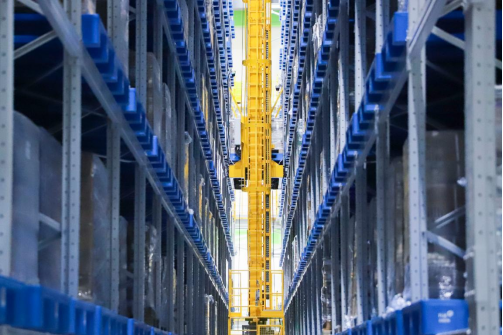
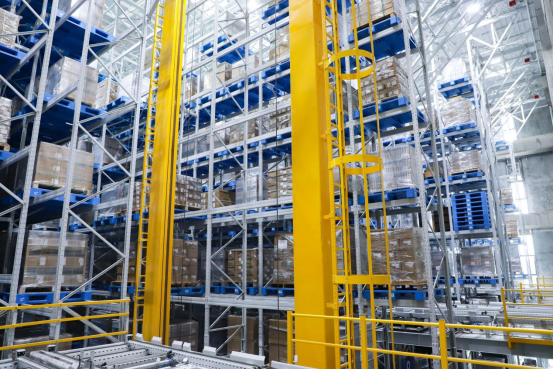
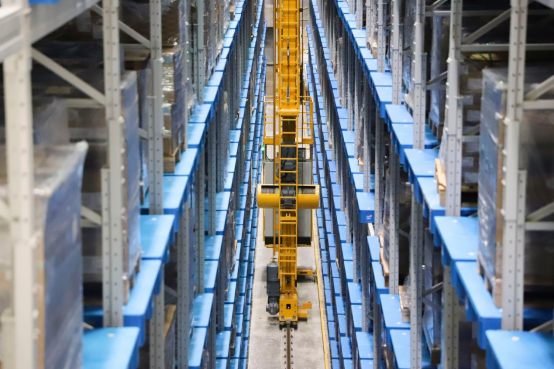
High-Bay AS/RS Core: Built in Phase 1, the facility’s 20+ meter clear-height automated storage and retrieval system (AS/RS) provides 6,000+ pallet positions served by six double-mast stacker cranes. To handle varied product weights, the bottom two tiers accommodate 1-ton (1,000 kg) loads while the upper eight tiers hold 0.8-ton (800 kg) loads. Engineered for high-throughput precision, the cranes achieve travel speeds of ≥180 m/min, lifting and fork-extension speeds of ≥60 m/min, a unit load capacity of 1 ton, and ±2 mm positioning accuracy.
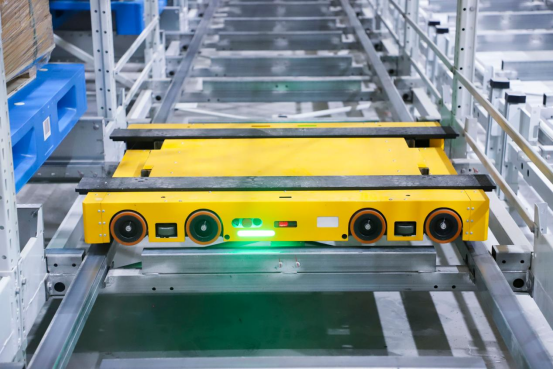
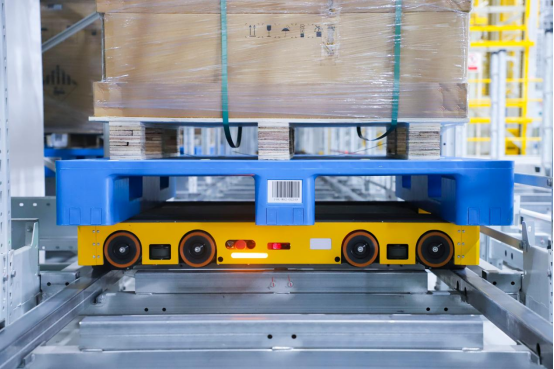
l High-Density Four-Way Shuttle System: To manage high-mix, small-batch materials requiring frequent rotation, KENGIC installed a 6.5-meter-high dense shuttle warehouse offering 1,000+ pallet positions. Twenty-one four-way shuttles navigate the racking independently, switching aisles automatically to balance long-cycle bulk storage in the AS/RS with agile, rapid-turnover fulfillment.
Synchronizing Four Floors into One Continuous Flow
The project’s defining engineering challenge was establishing high-speed, uninterrupted material movement across four active production floors:
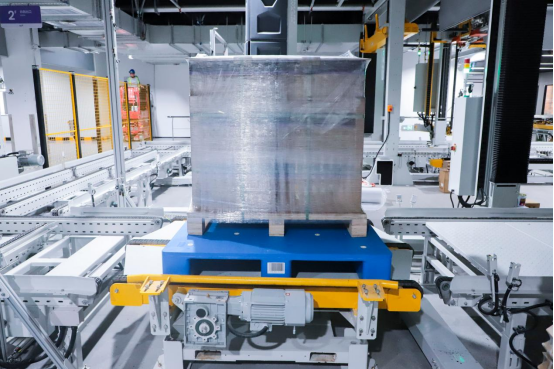
700+ Meters of Cross-Floor Conveying: KENGIC deployed a continuous conveyor network exceeding 700 meters in total length, incorporating nearly 100 lift-and-transfer units, turntables, and pallet-jack lifts. Independent conveyor loops on each floor connect seamlessly via vertical reciprocating conveyors (VRCs) to support dedicated floor-by-floor workflows:
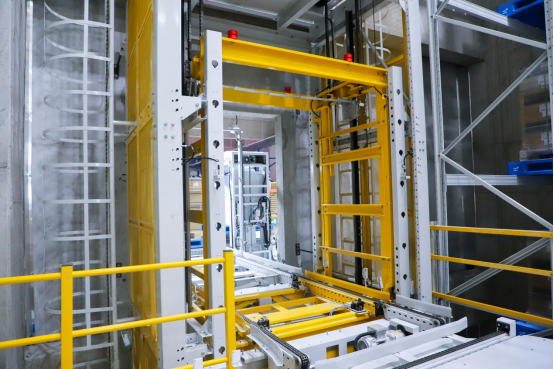
1F: Battery pack and related line delivery; raw material inbound through finished goods outbound
2F: Inverter and related line delivery; finished goods packaging and inbound storage
3F: DIP production line delivery
4F: SMT and DIP raw material delivery
Automated Master-and-Sub-Pallet Merging: To eliminate manual reconciliation errors between master pallets and sub-pallets during inbound and outbound operations, KENGIC integrated multiple automated pallet-merging stations. Utilizing adjustable-pitch forks and machine vision, the systems automatically split, merge, and bind inventory data across sub-pallet sizes ranging from 650×650 mm to 1,400×1,200 mm at a throughput of ≥23 pallets per hour.
Unattended End-of-Line Packaging: Prior to dispatch, finished goods move through an automated packaging zone featuring corner-protector application, horizontal and vertical strapping, top-film covering, and inline stretch wrapping. The fully unattended line operates at 30 pallets per hour per unit, eliminating manual intervention at shipment staging.
Simulation-Verified Software and Real-Time Digital Twin Control
To unify physical automation with enterprise operations, KENGIC deployed a three-layer digital control architecture:
Enterprise-Integrated WMS: The Warehouse Management System manages multi-warehouse operations, material attributes, inventory control, wave planning, and picking workflows. Seamlessly integrated with the manufacturer’s ERP, it supports configurable quality-inspection strategies and delivers full-chain digitization from procurement inbound to final shipment.
Intelligent WCS & Deadlock Verification: The Warehouse Control System acts as the central traffic orchestrator for all cranes, shuttles, VRCs, and conveyors, dynamically calculating optimal paths to prevent congestion. Prior to deployment, the system’s built-in deadlock verification mechanism was stress-tested across 100,000 simulated task runs, achieving a deadlock probability of less than 0.01%.
Real-Time Digital Twin: A live Digital Twin mirrors real-time warehouse operations, giving plant managers immediate visibility into equipment status, inventory distribution, and task execution. When an anomaly occurs, the platform automatically pinpoints the fault location, triggers alerts, and archives operational data for root-cause analysis and performance optimization.
A Blueprint for Scalable Clean-Tech Manufacturing
By re-engineering vertical storage, cross-floor transport, and real-time software orchestration as a single cohesive system, the Wenzhou campus establishes a scalable benchmark for smart intralogistics in the global solar and energy storage industry—ensuring material flow accelerates alongside automated production rather than holding it back.
We will reply you within 24 hours
COPYRIGHT ©2018 KENGIC INTELLIGENT TECHNOLOGY CO.,LTD..All Rights Reserved. 鲁ICP备18025465号-1 Powered by:Hicheng